

記事: Calacatta Viola Marble: Colour, Veining and How to Choose a Tray
Calacatta Viola Marble: Colour, Veining and How to Choose a Tray
Choosing a Calacatta Viola marble tray begins with looking at the stone, then considering what the tray needs to hold. The pale ground and darker veining can make a simple rectangular form visually active. A useful choice brings that pattern into balance with the size of the surface, the objects placed on it and the way the room is used.
What Is Calacatta Viola Marble?
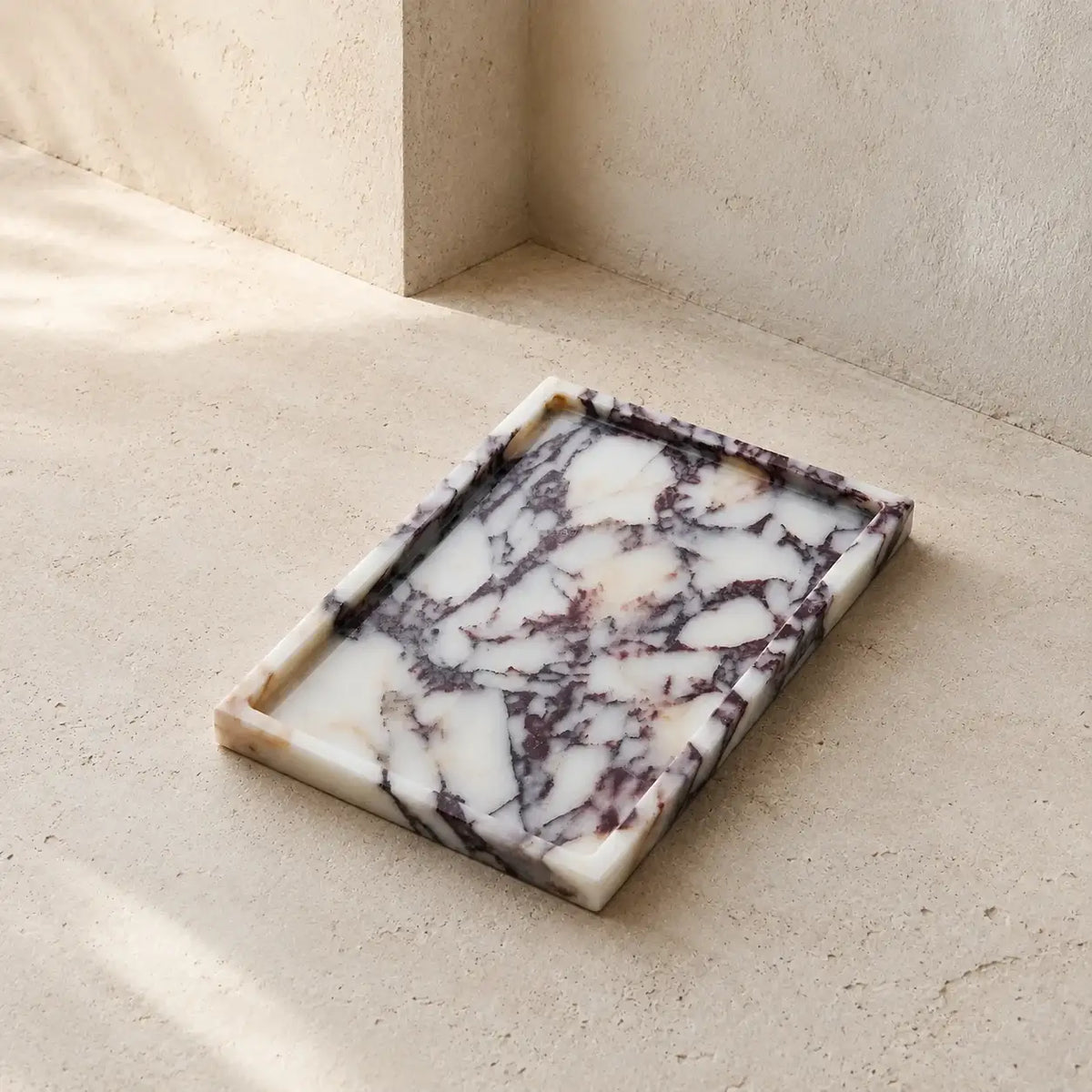
Within Verdora’s collection, Calacatta Viola identifies a natural marble with an ivory to creamy-white ground and contrasting burgundy, violet and grey markings. The name describes the material offered on the product page; it does not mean every piece has the same arrangement of colour. Look at the complete tray as well as the detail photographs to understand both its outline and its surface.
A material name alone also does not tell you the dimensions, finish or intended use of an object. Check those separately. A small rounded tray and a broader rectangular tray can share the same marble while providing quite different spaces for daily belongings.
Understanding Its Ivory, Burgundy and Grey Veining
Begin with the light areas. In the photographed Gallery Form, ivory sections create open spaces between darker, branching lines. Some markings read as burgundy; others appear purple-grey, especially beside the paler ground. The effect comes from the relationship between these areas, rather than from one dominant colour.
Then look at how the pattern travels. A line may continue across the flat surface and into the raised edge, making the rim part of the composition. Close views reveal smaller changes that are less apparent in a full photograph. Lighting and screens can affect how warm or cool the colours appear, so compare several views rather than relying on a single close-up.

Why Every Piece Looks Different
Natural variation is central to choosing this material. The spacing, direction and density of the markings can differ from one piece to another. Photographs show the character of the stone and the form of the object; they should not be read as a promise that a particular line will appear in exactly the same position on the tray you receive.
Decide which qualities matter most before ordering. You may be drawn to a broad pale area, a strong dark diagonal or a more evenly distributed pattern. If a particular balance is essential, ask about the current pieces before purchasing. A request for current photographs is more useful than assuming that a material name guarantees one fixed pattern.
How to Choose a Calacatta Viola Tray
Start with the available footprint. Measure the desk, shelf or console, then place a paper rectangle in the intended position. Arrange the objects you expect to use within it. This makes it easier to judge whether there is room to reach for glasses, lift a bottle or set down keys without crowding the surrounding surface.
The Calacatta Viola Marble Tray — The Gallery Form measures 30 × 20 × 1.8 cm. Its rectangular outline and low raised rim give everyday objects a defined place while leaving the stone visible around them. Those measurements describe the overall object; leave room for the rim when planning what will fit inside.
Consider the outline next. Straight sides can sit comfortably alongside books or the edge of a desk. Rounded and scalloped outlines introduce a different rhythm. Compare the proportions in our stone trays collection before deciding that colour alone should determine your choice.
Quiet Veining vs Expressive Veining
A quieter composition has more visual breathing room: larger pale areas or a less concentrated arrangement of darker markings. It can work well when a tray will hold several small objects that already differ in shape and colour. More expressive veining makes the empty surface a stronger part of the arrangement, especially when only one or two objects sit on it.
Neither approach is a quality grade. They are ways of describing visual preference. Think about the view you will have most often: from above at a desk, across a coffee table or from the doorway. A pattern that feels busy in a close photograph may read quite differently at that distance.
Styling Calacatta Viola with Walnut, Brass and Green
Walnut offers a warm, dark background against which the ivory areas can remain clear. Keep some wood visible around the tray so that its outline is easy to read. One book or a pair of glasses can be enough to establish scale without covering the pattern.
Brass introduces a smaller point of warm colour. Place a brass object where it can be seen against a pale area, rather than gathering every item in the centre. Green can enter through an object elsewhere on the desk or a nearby plant; it does not need to sit directly on the marble. Keep watering and wet pots away from the tray.

For a wider view of colour and form, explore our marble objects. If you are still choosing between materials, our separate notes on marble and travertine for the home address that comparison in more detail.
Care and Everyday Use
Dust with a soft cloth. For light marks, use a slightly damp cloth and dry promptly. Avoid acidic or abrasive cleaners and prolonged contact with oils, perfume or coloured liquids. Keep bottle bases clean and dry, and use a separate small dish where spills are likely. Lift objects when rearranging them instead of dragging them across the stone.
Follow the care information for the particular tray. Our marble and travertine care guide covers everyday cleaning and residue in more detail. General cleaning guidance is also available from the Natural Stone Institute.
A considered choice leaves room for both use and variation: the right footprint for the objects you keep nearby, a form that suits the surface, and veining you enjoy seeing each day.

コメントを書く
このサイトはhCaptchaによって保護されており、hCaptchaプライバシーポリシーおよび利用規約が適用されます。